

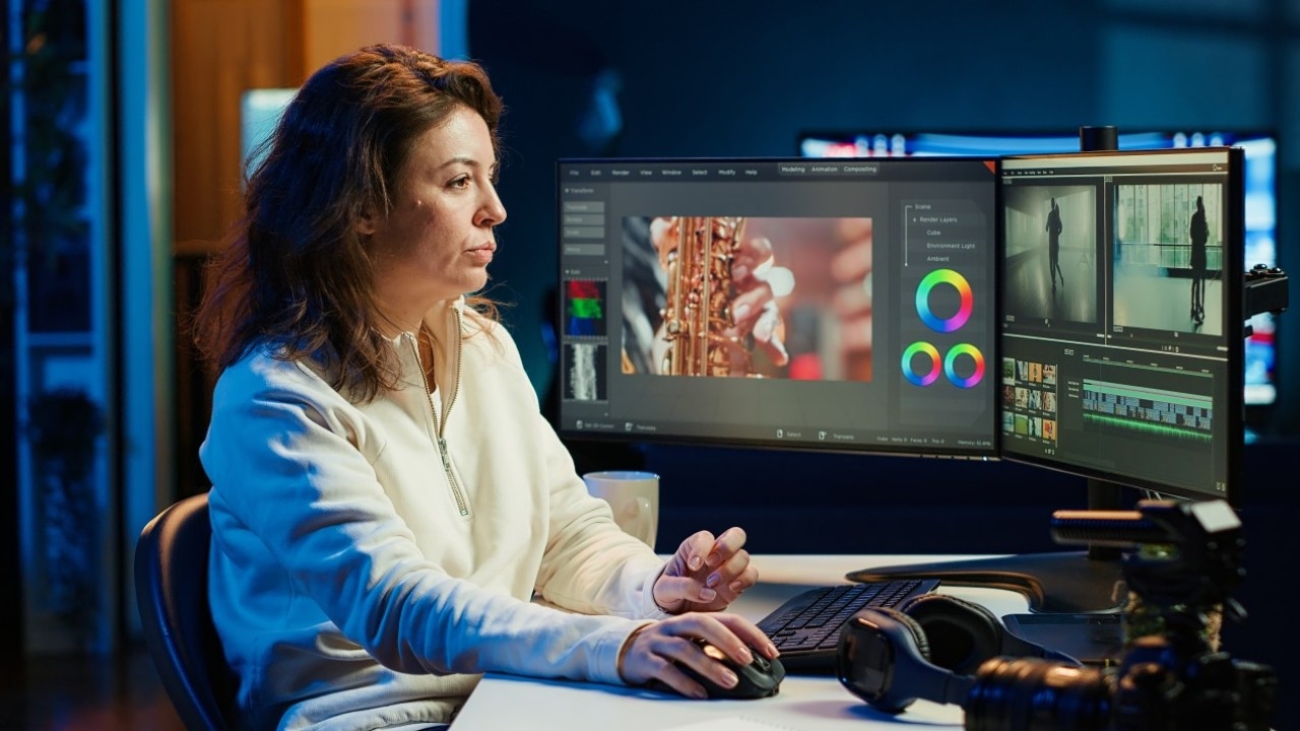
How AI Is Transforming Audiovisual Production (Without Replacing Human Creativity)
Artificial Intelligence is already an integral part of everyday audiovisual production. And no, we’re not talking about robots and algorithms making movies on their own, or about replacing creative teams overnight. What’s actually happening is something much more practical: AI is a powerful tool that’s helping us produce better, faster, and more efficiently.
Just a few years ago, certain technical tasks required hours of editing, endless revisions, or detailed and highly repetitive manual processes. Today, many of those processes can be streamlined significantly thanks to AI tools that allow us to optimize time and focus more effort on what matters: creativity and the message.
That’s where the difference lies: AI doesn’t replace audiovisual production. It enhances it, supports it, and can improve it.
There is some concern surrounding AI, especially in the creative sectors. But in audiovisual production, the reality is much more balanced.
AI can help generate automatic subtitles, organize recorded material, adapt videos to different formats, create quick translations, or streamline certain parts of pre-production and post-production.
But AI doesn’t decide how a scene or a script should feel or be emotionally framed. It doesn’t construct a coherent narrative with meaning, significance, and even symbolism on its own, and it doesn’t understand the true tone of a brand or product or how to connect emotionally with its audience.
In short: AI technology speeds up and streamlines processes. The creative judgment remains—and will continue to remain—human.
Less time on repetitive tasks, more time to create.
One of the major advantages of AI in production is precisely that: freeing up time.
When certain technical processes are partially automated, the team can devote more attention to the editing rhythm, visual aesthetics, narrative, or the viewer’s final experience.
For example, today it’s possible to generate a first draft of subtitles in minutes instead of doing it manually from scratch. You can also create quick versions for social media, adapt to vertical or horizontal formats, or perform initial audio cleanup much more efficiently. That doesn’t eliminate the need for professional review. But it does make the workflow much more efficient.
And in an environment where turnaround times are getting faster and faster, that makes a huge difference.
AI is also transforming content.
Beyond the technical aspects, Artificial Intelligence is opening up new creative possibilities. Today, it’s possible to generate visual assets, backgrounds, animations, and graphic elements that previously required much longer or more expensive processes. It’s also possible to rely on intelligent tools to plan content, generate visual ideas, or explore creative concepts much more quickly.
This is allowing smaller productions to access graphics, finishes, and effects that were previously only within reach of large budgets. And for companies, brands, or content creators, that means more possibilities without having to increase costs.
But be careful: AI as a tool doesn’t work magic.
This is where the most important aspect comes in. AI can greatly speed up the work… but it doesn’t guarantee a good result on its own.
In fact, when used without judgment or review, it shows. Impersonal edits, artificial text, incoherent images, or content that technically works but conveys nothing. Technology can help you produce faster. But if there’s no idea behind it, no clear narrative, and no coherent visual direction, the content loses its value—its soul. That’s why the difference still lies in who uses the tool and how they integrate it into the creative process.
The future of audiovisual production will be hybrid.
Everything points to AI continuing to evolve within the audiovisual sector. It will likely play an increasingly significant role in editing, localization, task automation, and the generation of visual assets. But far from replacing human creativity, the most interesting aspect is how it can enhance it.
The camera will still need a human eye behind it, lighting will still require intention, and a brand will still need personality and depth.
Technology changes. The need to connect with people does not.
How we work with AI at Lucentum Studios.
At Lucentum Studios, we view Artificial Intelligence as a tool to improve processes and enrich productions, not as a substitute for creative work. This allows us to reduce production times and costs, optimize resources, and deliver more dynamic results without losing creative control or compromising final quality.
Because technology can help you get there faster, but what matters most is arriving with content that moves and resonates.
At Lucentum Studios, we know how to infuse your audiovisual productions with soul, visual appeal, and an emotional depth that connects, conveys, and ultimately communicates exactly what you want.
Call us and let’s talk about your project. We’ll bring it to life.